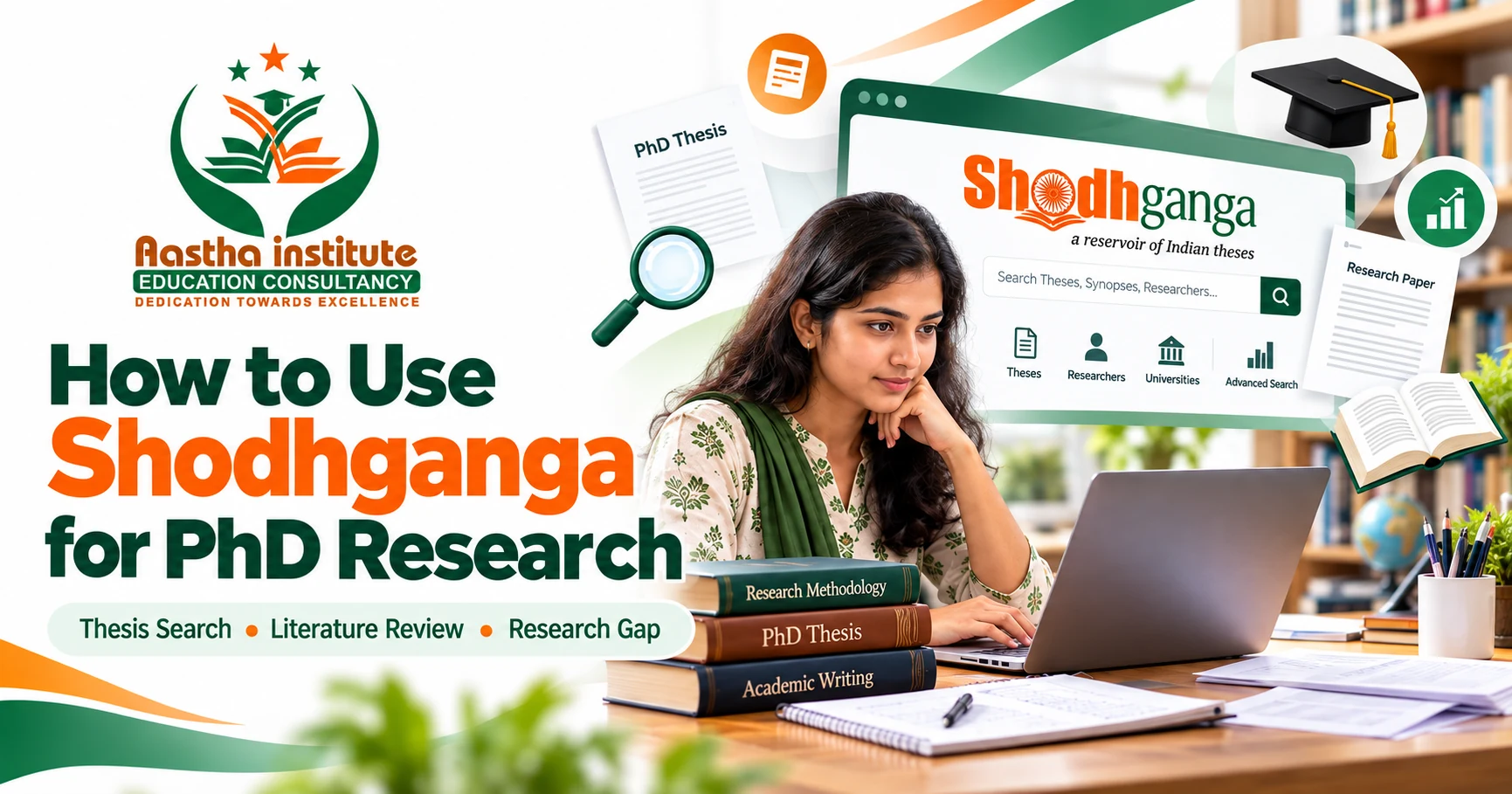
Shodhganga Is an INFLIBNET Research Repository
Shodhganga is an open-access digital repository maintained by the INFLIBNET Centre. It provides access to electronic theses and dissertations contributed through higher educational institutions in India and can be an important discovery resource for doctoral researchers.
What Is Shodhganga?
Before finalising a PhD research problem, scholars need to understand what has already been investigated. Shodhganga provides access to a large body of Indian doctoral research that can help scholars examine previous studies within their subject area.
A thesis can show how another researcher framed a problem, reviewed literature, selected a methodology, collected data, analysed findings and discussed limitations. The purpose is to understand and critically evaluate earlier research—not to reproduce another scholar's work.
How Can Shodhganga Help a PhD Scholar?
Literature Discovery
Find previous doctoral work and discover useful researchers, theories, references and academic sources related to your topic.
Research Topic Refinement
Compare previous objectives, populations, locations and variables before narrowing your own research problem.
Methodology Comparison
Study how previous researchers used samples, instruments, research designs and analytical techniques.
Research-Gap Exploration
Compare findings, limitations and suggestions for further research to identify questions that may deserve additional investigation.
How to Search PhD Theses on Shodhganga
Shodhganga provides repository search, advanced search and subject-oriented discovery facilities. Effective research normally requires several keyword combinations instead of only one exact phrase.
- Start with the core topic. Search the principal concept using clear keywords.
- Try alternative terminology. Search synonyms and related terms because researchers may describe similar concepts differently.
- Add a population or sector. Combine the subject with terms such as students, teachers, consumers, employees, universities, SMEs or another relevant group.
- Add geographical terms. Use India, state, region, district or city terms when geography is important to the research question.
- Compare several theses. Do not rely upon a single thesis. Compare objectives, methodology, findings and limitations across multiple studies.
- Follow useful references. A relevant thesis can lead to journal articles, books, reports and other original scholarly sources.
How to Use Shodhganga for Literature Review
A PhD literature review should not merely summarise earlier documents. It should organise and critically compare existing knowledge in relation to the research question.
- Record the thesis title, researcher, institution and year.
- Note the research objectives and research questions.
- Identify important theories or conceptual frameworks.
- Review the population, sample and research design.
- Compare findings with other studies on the topic.
- Review stated limitations and suggestions for future work.
- Trace important references back to their original scholarly sources wherever possible.
Do Not Build a Literature Review Only from Theses
Shodhganga can be extremely useful for research discovery, but a doctoral literature review should normally also consider recent peer-reviewed journal articles, academic books, authoritative reports and appropriate scholarly databases.
How to Explore a Research Gap Using Shodhganga
A research gap is not simply a keyword that produces few search results. A defensible research gap normally emerges after systematic comparison of existing evidence.
| Area to Compare | Questions to Ask |
|---|---|
| Objectives | Which questions have already been investigated, and which related questions remain insufficiently examined? |
| Population | Have earlier studies concentrated on another age group, occupation, sector or type of respondent? |
| Geography | Is existing research concentrated in particular regions, states or cities? |
| Time Period | Could technological, regulatory, economic or social changes justify updated investigation? |
| Methodology | Could a different design, data source, sample or analytical approach answer the research question more effectively? |
| Limitations | Which limitations identified by earlier researchers can reasonably be addressed through a new study? |
Verify the Gap with Recent Research
Once a potential gap has been identified from theses, check recent journal literature and suitable scholarly databases. A thesis deposited several years ago may not reflect newer studies.
Example: From a Broad Topic to a Research-Gap Search
Suppose your broad topic is digital marketing and consumer buying behaviour in India. Instead of searching only this exact phrase, try combinations involving digital marketing, social media marketing, online advertising, consumer behaviour, purchase intention, industries and geographical areas.
Compare relevant theses by period, location, population, variables, methodology and findings. If a possible gap appears—for example, limited work involving a particular population—verify it against newer scholarly literature before finalising the research problem.
Shodhganga vs ShodhGangotri
| Repository | Primary Research Use |
|---|---|
| Shodhganga | Provides electronic theses and dissertations and is particularly useful for studying completed doctoral research. |
| ShodhGangotri | Includes approved research synopses/proposals and research in progress, along with certain other research materials. It can help researchers understand current research directions and possible overlap. |
Can You Cite a Thesis Found on Shodhganga?
Yes. When a thesis contributes an idea, finding, quotation, methodological approach or other material used in your research, cite the thesis according to the academic style required by your university, supervisor or publication.
If you discover an important journal article or book through a thesis bibliography, locate and evaluate that original source whenever possible rather than relying solely upon another researcher's description of it.
Shodhganga, Open Access and Plagiarism
Open access does not mean permission to copy. Researchers remain responsible for correct quotation, paraphrasing, citation and compliance with the academic-integrity requirements of their university or publication.
Practical Shodhganga Research Checklist
- Define the core research concept before searching.
- Prepare alternative keywords and synonyms.
- Search and compare multiple relevant theses.
- Compare objectives, methodology, findings and limitations.
- Prepare a literature-review matrix or research table.
- Trace important references to their original sources.
- Verify a potential gap against recent journal research.
- Maintain complete citation details.
- Avoid copying thesis language or structure.
Official Research Sources
Shodhganga — INFLIBNET
https://betasg.inflibnet.ac.in/
INFLIBNET Centre
https://www.inflibnet.ac.in/
Frequently Asked Questions
1. What is Shodhganga?
Shodhganga is an open-access digital repository maintained by the INFLIBNET Centre for electronic theses and dissertations contributed through Indian higher educational institutions.
2. Is Shodhganga useful for a PhD literature review?
Yes. It can help identify earlier doctoral research, methodologies, findings, limitations and useful references. Researchers should also review recent peer-reviewed and other relevant scholarly literature.
3. Can Shodhganga help identify a research gap?
It can help identify potential gaps through comparison of earlier doctoral studies. Any possible gap should also be verified against recent scholarly literature before a final research problem is selected.
4. What is the difference between Shodhganga and ShodhGangotri?
Shodhganga primarily contains electronic theses and dissertations, while ShodhGangotri includes approved research synopses/proposals and information concerning research in progress and certain other research materials.
5. Can I cite a thesis from Shodhganga?
Yes. Cite the thesis according to the citation style and academic requirements applicable to your research.
6. Can I copy material from a Shodhganga thesis?
No. Open availability does not remove normal academic-integrity and citation responsibilities. Quote, paraphrase and cite appropriately.